
I was diagnosed with arthritis in my hips at age 41. “Very common for a woman your age,” the surgeon said. Eye roll. A woman my age? Why not just say, “Very common as we get older?” But I digress.
I looked around the waiting room that morning in 2016 and thought, there is no way my hip is this bad. People with walkers and canes. People getting up and moving like tortoises. Was this something to worry about right now? I thought.
“Don’t worry,” the surgeon said to me. “I’ll see you in 10 years for a hip replacement.”
I smirked. I was definitely not going to see him in 10 years for a hip replacement. No chance I was going to need a new hip. And if I did, it certainly was not going to be from him. Ever heard of a bedside manner, Doc?
And yet, he was right.
Ten years later, I decided it was time to see an orthopedic hip doctor this past January. Walking had gotten much harder and I was having more difficulty taking stairs. I started taking an adult ballet class in October of 2025 and was so excited to be back in class – until the first class left me crippled with pain. I thought it was just that it had been about five years since I had last done ballet. Nope. The second class hurt again, maybe a little bit less but still painful. Every move felt like my hip was being torn out of my hip socket. Yet, I continued to take class thinking I just needed to stretch more.
On vacation with my husband Diego to Portugal and Morocco in October of 2025 absolutely destroyed me.
I had never hurt as much as I did on my last day in Casablanca. I was in so much pain, we had to cut our exploration of the markets short. When I got back to the hotel, I stretched and stretched and beat my glutes. I had no clue why I hurt so much.
By December, Diego was walking ahead of me on every outing we took. My hip would give out if I stood on my right leg to put my pants on. I was squatting to a higher and higher box. I had to start strict pressing. Deadlifts were okay but the weight had stalled and then started going backward. My leg permanently turned out when I was on the spin bike. I was beginning to walk with a considerable limp. It was finally time to meet with a specialist.
“Osteoarthritis. In both hips. Bone spurs, almost bone on bone in the right hip. Yep, it’s not good. You can try injections and drugs, but your best bet is a total hip replacement. And at your age, you would do great.”
Dr. Kovaks, looking at my x-ray.
I immediately thought back to that first doctor, who had been my dad’s surgeon. He had been right. My father had been diagnosed with arthritis in his hips when he was 40 and the doctor told him then that he would need a hip replacement in 10 years. Like father, like daughter. My father was told at 50 that he needed a new hip. He decided to stick with injections and drugs and did not have his first one until age 65. I was not going down that route.
I made an appointment with the hip surgeon at the end of January and decided to have the hip done. Originally, I made the appointment for the end of May but I moved that up to early April as the pain started to become too much to bear. We moved the appointment to April 13, 2026, and I am so glad I did not wait.
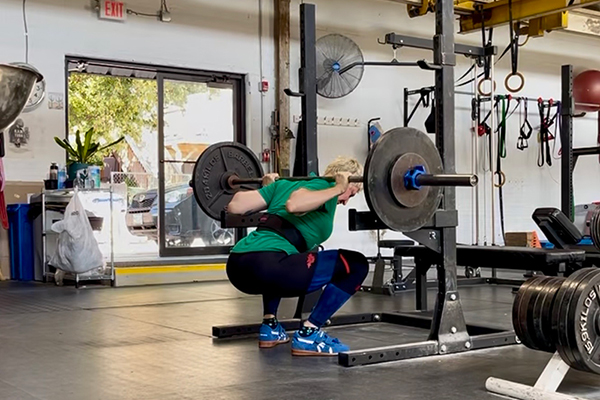
Training into surgery
Prior to my surgery, I continued to train as normally as possible. The only changes I made to my program were:
Squat
To a high box as I could not go below parallel without pain.
Bench
No change, but the position pushed my hips to the limit.
Press
Strict only. My hips hurt when I moved them forward.
Deadlift
With lower weight to accommodate what my hips would allow.
Benching was fine but I definitely paid for it afterwards; it was hard to walk. Although I was a little stubborn on this front, I knew that I was not making things worse.
I made a point of training as much as I could leading up to the surgery as I knew the stronger I was going into the surgery, the better. I spoke to Emily Burrows, the wife of Steve Hill, who had just had her second hip replacement. She and Steve gave me a lot of information about what to do after the surgery, how to take care of myself and when I might be able to start training again. I also made an online appointment with John Petrizzo, SSC DPT to discuss the hip surgery and what to expect afterwards. We also scheduled a day to talk a week after the surgery to see where I was and discuss how to proceed with my training.
While most people preparing for surgery are buying grab bars, raised toilet seats, and sock aids, I was planning my return to the gym. I had my priorities.
Monday, April 13, 2026
It was a total right hip replacement, anterior approach. There are 3 types of hip replacements: anterior, posterior, and lateral. The most common procedures are the anterior and posterior, and most surgeons perform the anterior approach as there are fewer restrictions on the patient after the surgery. The anterior approach also allows a person who is very active prior to surgery get back to their regular routine faster.
The operation took about two hours from start to finish, 7:30am-9:30am. I came out of anesthesia around 10:30, and they got me up and walking around by noon. They watched me take the stairs, get in and out of a “car,” and then sent me home around 1pm. And that was that. No physical therapy scheduled. No surgeon talking to me about the surgery. Picked up my medications and was wheeled out to the car. Buh-bye!
My First Week
I realized immediately that this was not going to be like my knee surgery back in 2019. I could definitely not go back to work the next day like I had after my meniscus root repair. (Yes, I went to work the day after my knee surgery and trained too. I felt great!) Although I was weight-bearing and encouraged to walk as much as I could (unlike the knee surgery where I was 6 weeks non-weight bearing), I was also on multiple drugs (Tylenol, baby aspirin, tramadol and meloxicam) and would get exhausted after doing the slightest bit of movement. Sleeping was tough and my days after surgery were spent icing my hip and thigh, doing my rehab exercises on the couch, walking around the living area and taking the stairs a couple times.
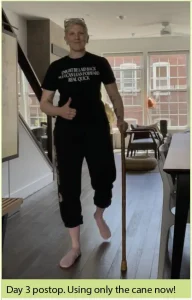
I used my walker on Monday (day of surgery), Tuesday and Wednesday of that week.
By Thursday, I was practicing with the cane and taking the stairs using alternate legs. By Friday, my mother picked me up on her way to the gym and I got to visit with my members. Saturday, I went to the gym again with Diego and did a few bodyweight squats to an 18” box, a set of RDLs with a 15lb bar and a couple strict presses with the same bar. On Sunday, I began my gym rehab with squats again, RDLs, and strict presses.
The next day, I was back at work, despite my surgeon telling me not to be. He didn’t know me or my job. I figured I could sit at home and ice my hip or sit at the gym and ice my hip. And I’d rather be at the gym.
My private clients that I have in the mornings on Monday/Wednesday/Friday picked me up from my house and drove me to the gym in the mornings. I only live six blocks away from the gym but I was not allowed to walk that far just yet nor was I allowed to drive. So for the first two weeks after surgery, I had rides to and from the gym thanks to my awesome members. My coaches helped me out for those two weeks as well and I was able to ease back into coaching part time, working just the morning or just the evening. This helped tremendously because I was definitely tired after each coaching session.
My first Wednesday morning back, I did way too much and paid for it later. I was not in pain, just utterly exhausted, and feeling the way I feel when I’m getting sick. I learned my lesson and acknowledged that I needed to listen to my body and sleep if I needed to.
I put together my training program slowly the first week back, testing out my squat, my bench, and press. A week later, I talked to John again and reviewed my training program with him. We discussed what I could and could not do…and there was definitely more of what I could do than not. Nothing was really off limits except for the rowing machine and the hip movement in the press. Everything else was fair game.
Here is what my training program looked like from 4/20/26 (one week after surgery) to 5/7/26. I continued to lower the box each time if I was able to do 5 reps without issue. I started with an 18” box.
The program
Nothing fancy—the basic lifts, modified and then un-modified.
01
Apr 20 – May 7 · Week 1–3
Starting with an 18” box, I lowered it each time I could do 5 reps without issue.
| Sunday | Monday | Tuesday | Wednesday | Thursday | Friday |
|---|---|---|---|---|---|
| BW Squat to a box | Bench (feet on 8” box) | BW Squat to a box | Bench (feet on 8” box) | BW Squat to a box | Bench (feet on 8” box) |
| Press | Tricep work | Press | Tricep work | Press | Tricep work |
| Rack Pulls | Curls | Rack Pulls | Curls | Rack Pulls | Curls |
| Leg extensions | BW Step ups | Leg extensions | BW Step ups | Leg extensions | BW Step ups |
| Rows or Lat pulldown | Rows or Lat pulldown | Rows or Lat pulldown |
Even though I was not prescribed physical therapy, I did make an appointment with a PT who is also an orthopedic specialist and just happened to be a former member of ours so I knew I was in good hands. I visited him about three weeks after my surgery and he did an evaluation. I was in pretty good shape already but he did give me a few extra exercises to add into my program. In between my big lifts and my accessory work, I do my “PT” exercises: leg lifts, balance work and single leg deadlifts. He also evaluated my squat and gave me the go-ahead to start squatting with the barbell.
02
May 7 – Jun 12 · Week 3–9
After meeting with Dan: the barbell comes back for the squat, and PT work goes in every day.
| Sunday | Monday | Tuesday | Wednesday | Thursday | Friday |
|---|---|---|---|---|---|
| Barbell low box squat | Bench | Barbell low box squat | Bench | Barbell low box squat | Bench |
| Press | Tricep work | Press | Tricep work | Press | Tricep work |
| Deadlift | Shoulders | Deadlift | Shoulders | Deadlift | Shoulders |
| Leg extensions | Curls | Leg extensions | Curls | Leg extensions | Curls |
| Rows | Step ups | Rows | Step ups | Rows | Step ups |
By the 9-week mark, I decided it was time to move back to a four-day split like I had been doing prior to surgery. Since I was now below parallel, the box squat was getting more challenging and my deadlifts were getting heavier. I decided to start doing a pause squat on my second squat day and keep the “heavy” squat to the box. I was still benching with my feet elevated but was slowly working them down to the floor. I was also told to stick to the strict press until the 16-week mark per John’s recommendation.
03
From Jun 15 · Week 9
A four-day split, with a bike day midweek.
| Monday | Tuesday | Wednesday | Thursday | Friday |
|---|---|---|---|---|
| Heavy Bench | Barbell box squat | Bike | Heavy Press | Heavy Deadlift |
| Viking Press | Light Deadlift | Volume Bench | Pause Squat | |
| Assistance exercises | Leg extensions | Assistance exercises | Leg extensions | |
| Step ups and SL DL | Step ups and SL DL |
In the beginning, I was adding 5 pounds a session, 15lbs a week to the bar for squats and deadlift. At week 8 I moved to 10lbs a week, and at week 10 to 5lbs. I worked up to fairly heavy weight for the bench and press given my modifications so now I am slowing the bench weight down as I work to get my legs back to the floor and slowing down the reps as I increase the strict press before I can use my hips again.
Wrap Up
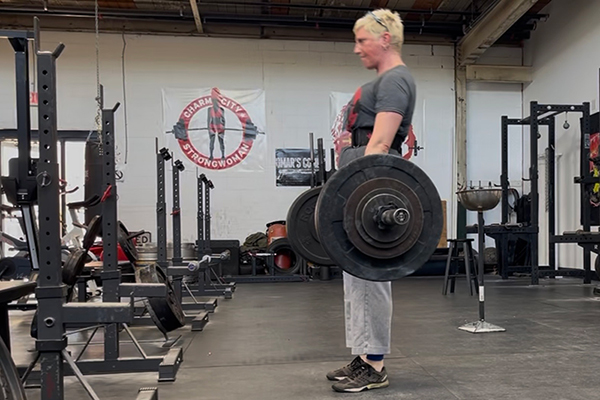
July 13, 2026 was my three-month mark since my total hip replacement. At three months, I squatted 135lbs, below parallel, for the first time in almost a year without pain. I deadlifted 160lbs. I strict pressed 80lbs and have finally worked my legs to the floor for the bench. I could not be happier with my progress.
One month later, my program as of August 2026 looks like this:
| Monday | Tuesday | Wednesday | Thursday | Friday |
|---|---|---|---|---|
| Heavy Bench | Heavy squat | Bike | Heavy Press | Heavy Deadlift |
| Viking Press | Stiff legged DL | Volume Bench | Pause Squat | |
| Assistance upper body | Leg extensions | Assistance upper body | Leg extensions | |
| Weighted step ups | Split squats | Weighted step ups | Snatch grip RDLs |
At month five, I have now squatted 155lbs (my bodyweight!), deadlifted over 200lbs, pressed over 85lbs and I am benching in the triple digits again with both feet firmly planted on the ground. I am pretty much back to normal training and moving in the right direction: up.
Before my surgery, I desperately searched for recovery videos from hip replacements on YouTube and found nothing. Not one video of someone rehabbing their hip using strength training. Not one. So I had to make one myself. And write this article. There was nothing I could find online for individuals who are actively strength training and want to know how to get back to training after surgery. Nothing.
So what made my recovery so fast? Strength.
If I had not spent the 16 years of my life squatting, benching, pressing and deadlifting, I would not have had the strength to continue to be as active as I was after the surgery and I would have had no idea how to rehab my hip on my own, instead of relying on physical therapy for my rehab.
People focus so much on the rehab after surgery but never think about the prehab that one should do beforehand. Your prehab should be happening NOW. Not the week before your surgery. One week prior to a surgery is not the time to realize that you should have been doing something before this happened. Even if you are in discomfort, keep moving. Your prehab should start years before.
Having a hip replacement this past April was not on my bingo card this year. But I knew this might be something in my future as I had been experiencing more hip pain than usual for the past two years.
I was not nervous. I was not scared. I was not concerned. I was strong.
I had rehabbed my knee well and I would rehab my hip, too.
Strength isn’t just about lifting heavier weights. It’s insurance for the life you haven’t lived yet.
Bodies wear out. Accidents happen. Surgeries happen. You don’t get to choose those things. What you can choose is how strong you are when they happen. The stronger you are, the harder you are to break, the faster you recover, and the sooner you get back to living your life.
First published in StartingStrength