

At 88 years old, maintaining strong bones is an important part of preserving independence, mobility, and quality of life. And despite what some people might think, one CAN continue to build bone and preserve bone density as one ages IF they start strength training. And yes, one can start a strength training program at any age. ANY age.
My client Mona’s bone density testing over the past several years tells the story of a woman whose skeletal health has remained remarkably resilient despite the natural aging process. I met Mona for the first time in March of 2023, just about three weeks before her 85th birthday. She came with her daughter Liz to the gym one weekend. I showed her how to squat and taught her how to get down to the floor and get back up. After this impromptu session, she was hooked and started strength training with me at the beginning of May 2023.
For a number of years, Mona had received cortisone injections for her left knee because of pain and soreness when she walked. Her orthopedist suggested surgery, but she resisted because she didn’t trust his judgment. Then, one morning in early February 2020, her knee suddenly “popped” and she couldn’t walk on it. Unfortunately, there was one problem. COVID was in full swing and physician offices were closed, especially for elective surgeries. This finally lifted in late June, and she had her left knee replacement on July 7, 2020.
Her rehab working with a physical therapist took several months. The long period during which her leg was not used led to ligament shortening and generalized weakness in the left leg. In addition, the “popping” in her leg was the fibula slipping sideways and out of place, which was corrected during the surgery.
After her left knee replacement, she was scared to do anything with her knees. She had done physical therapy but no one had encouraged her to do any strength training AFTER physical therapy was over. No one helped her learn how to get down to the floor after her knee replacement and she was definitely very nervous to try for fear of hurting her knee. We spent that Saturday morning in March learning how to get down and get up, and that’s all it took for her to be convinced that this was something she needed to start doing on a regular basis.
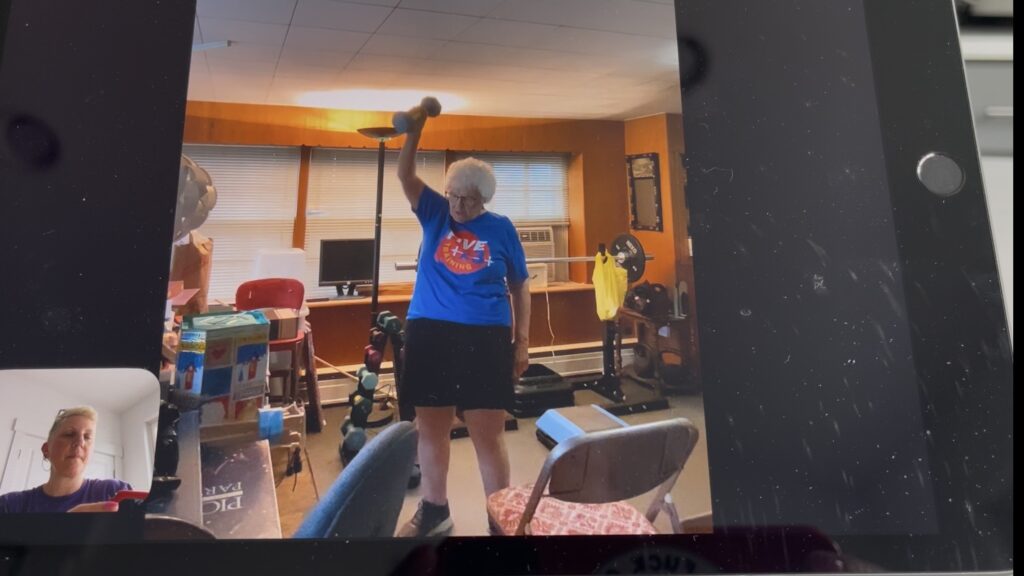
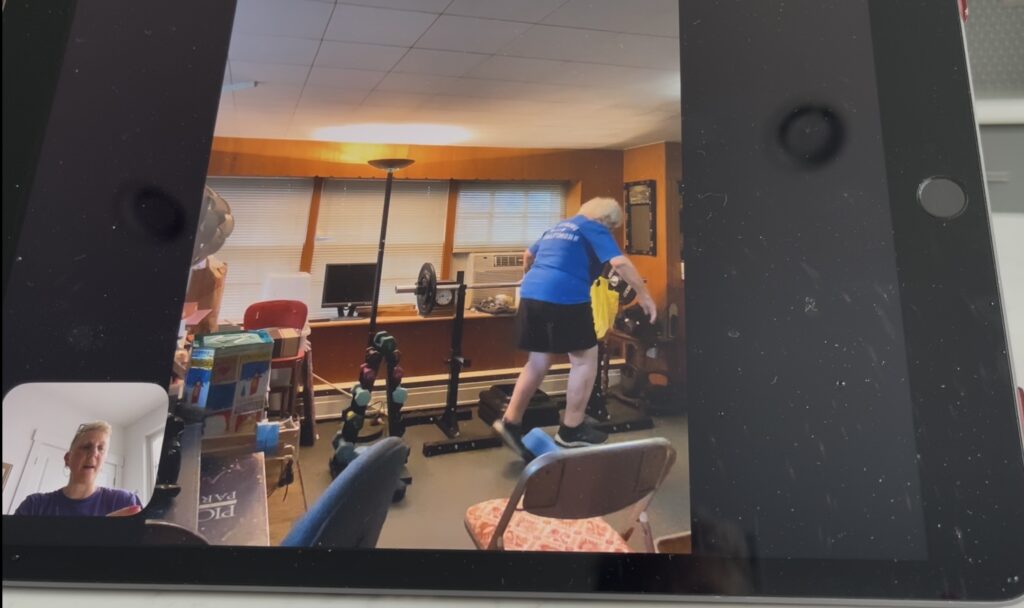
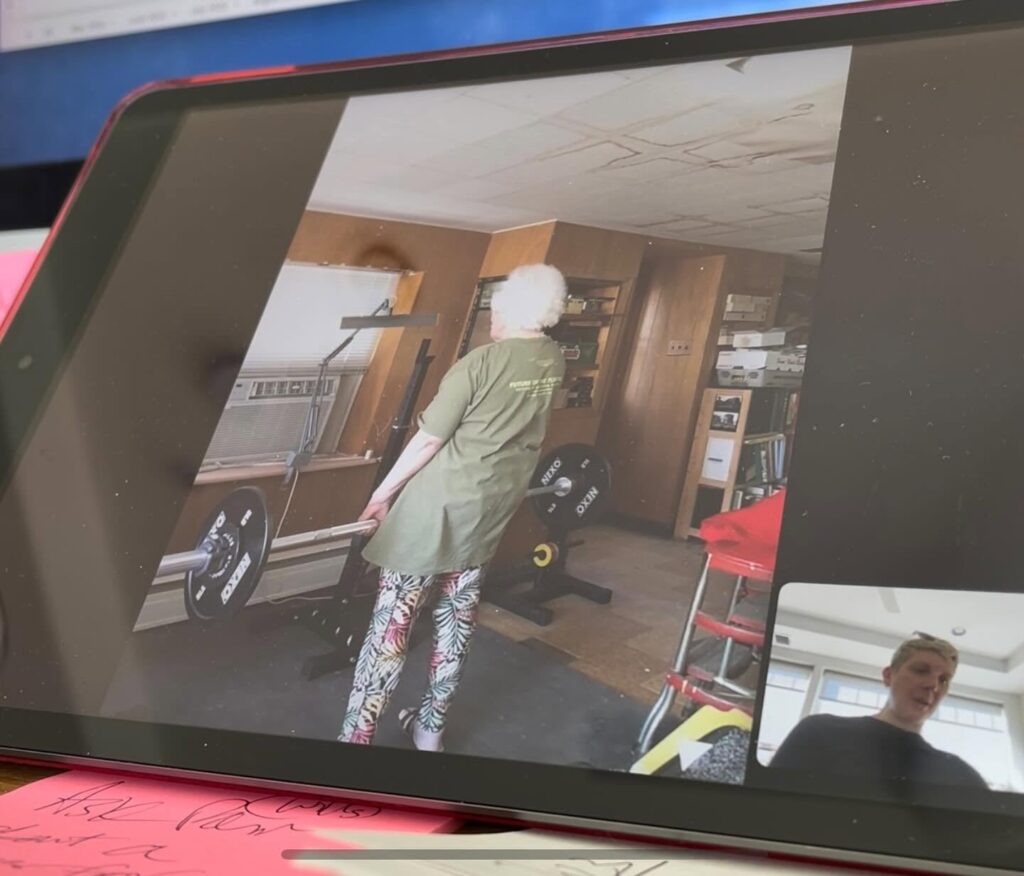
Mona contacted me at the end of April to get started. All of our sessions are done over FaceTime as Mona lives in New Jersey so in person sessions were not a possibility. She was very deconditioned when we began so we started slowly with 10-15 minutes, once a week. She worked out in her living room using her dining room chair, 2lb dumbbells, bands and a box for deadlifts. By December 2023, she had a rack, 10lb barbell, bumper plates, heavier dumbbells and kettlebells and her new gym set up was now in her basement. Since her gym was now downstairs, this meant Mona had to take the stairs up and down for our workouts, an added bonus to her program. By this time, she had also decided she needed to move to training twice a week starting in January 2024.
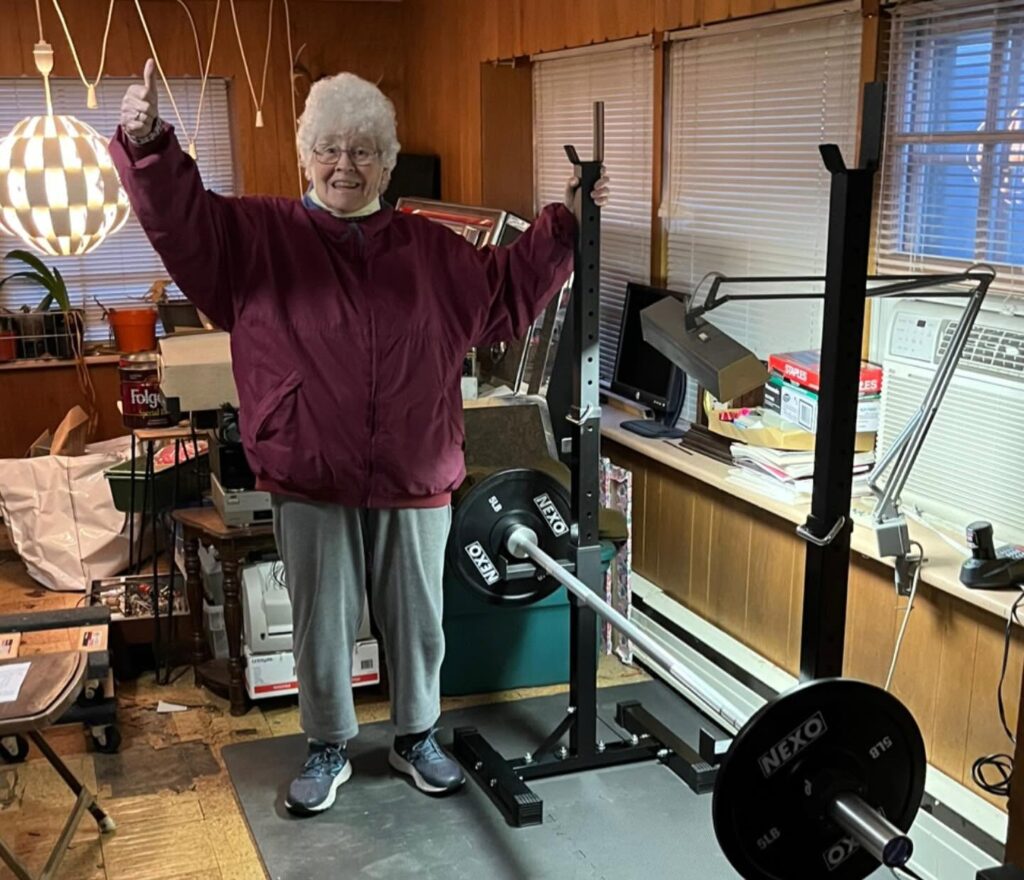
Her program in the beginning of May 2023 looked like this:
Day One
| Exercise | Load | Reps | Load | Reps | Load | Reps |
| Squat | BW | 5 | BW | 5 | BW | 5 |
| Press | 2lbs | 5 | 2lbs | 5 | 2lbs | 5 |
Day Three
| Exercise | Load | Reps | Load | Reps | Load | Reps | Load | Reps |
| Squat | BW | 6 | BW | 6 | BW | 6 | BW | 6 |
| Press | 2lbs | 6 | 2lbs | 6 | 2lbs | 6 | 2lbs | 6 |
| Box Deadlift | 6lbs | 5 | 6lbs | 5 | ||||
| Pull-aparts | 10 | 10 |
By January 2024, we had progressed to a lower chair and weight for squats and a barbell for deadlifts. Her program by January looked like this:
| Exercise | Load | Reps | Load | Reps | Workset |
| Squats – Low chair | 5lbs | 5 | 8lbs | 5 | 10x5x1 |
| Pull-aparts | 10 | 10 | 10 | 10×3 | |
| Presses | 5lbs | 5 | 8lbs | 5 | 10×5, 8×5 |
| Step ups to box | BW | Four each side | 4/4×3 | ||
| Deadlifts | 20lbs | 3 | 20×3 |
Mona had her most recent bone density evaluated through DEXA scans performed in 2023 and 2026. These studies measure bone mineral density in the lumbar spine and both hips and provide a picture of how bones have changed over time. According to the WHO (World Health Organization), a T-score of -1.0 or above is normal. A score between -1.0 and -2.5 indicates osteopenia, a condition where bone density is below normal and may lead to osteoporosis. And a T-score of -2.5 or lower signals osteoporosis, a disease characterized by fragile bones and an increased risk of fractures.
Her last scan before the one in 2023 had been in 2019, one year before her knee replacement. Two weeks after she started training with me in May of 2023, Mona had her DEXA scan.
These were her results from her 2023 scan:
| Site | BMD | T-score | Interpretation |
| Lumbar Spine (L1-L4) | 1.192 | 0.0 | Normal |
| Left Total Hip | 0.901 | -0.8 | Normal |
| Left Femoral Neck | 0.834 | -1.5 | Osteopenia |
| Right Total Hip | 0.900 | -0.9 | Normal |
| Right Femoral Neck | 0.881 | -1.1 | Osteopenia |
Between 2019 and 2023, significant loss had occurred in the spine and left hip. Osteopenia was present in both femoral necks. No osteoporosis had developed and her spine remained normal despite the decline.
According to the 2023 report, there was a significant 3.4% decline in spine density and a significant 10.3% decline in the left hip since 2019 but the actual T-scores in 2023 remained remarkably good for a woman in her mid-80s.
After three years of strength training, Mona had another DEXA scan this past June of 2026. Her results were definitely significant as she had made improvement in her spine and right hip. There was a slight decline in her left hip but I am sure that this had everything to do with her knee replacement and her hesitancy over the years to use that leg and use more of her right leg.
These were her results from her scan in June of 2023:
| Site | BMD | T-score | Interpretation |
| Lumbar Spine (L1-L4) | 1.220 | 0.2 | Normal |
| Left Total Hip | 0.872 | -1.1 | Osteopenia |
| Left Femoral Neck | 0.834 | -1.8 | Osteopenia |
| Right Total Hip | 0.900 | -0.8 | Normal |
| Right Femoral Neck | 0.881 | -0.8 | Normal |
Spine: Change: + 2.3% – Increase from 2023 (statistically significant)
Left Total Hip: Change: -3.2% – Small decline in measured BMD, but no significant change
Right Total Hip: Change: +0.6% – Essentially stable from 2023 to 2026
Right Femoral Neck: Change: +4.4% – Improved between 2023 and 2026
Between 2019 and 2023, Mona experienced measurable bone loss, particularly in the left hip. The radiologist documented a statistically significant 10.3% decrease in left hip bone density and a 3.4% decrease in the spine. Despite this decline, her bone density remained within the normal range at most sites, with only mild osteopenia at the femoral necks.
The more recent period, from 2023 to 2026, tells a different story. Rather than continuing to lose bone, her skeletal health stabilized. The lumbar spine actually increased by 2.3%, while both hips showed no statistically significant change.
Many women in their late eighties have osteoporosis, particularly at the hip, where fracture risk becomes a major concern. Mona’s results are very unusual because she has maintained normal spine density, normal to improved right hip density, only mild osteopenia in the left hip, stable fracture risk, preserved bone microarchitecture and no osteoporosis diagnosis
The most important finding is not that her numbers are perfect—they are not—but that after experiencing some age-related bone loss between 2019 and 2023, she appears to have reached a period of stability. The 2026 report specifically states that there has been no significant change in either hip since 2023.
For an 88-year-old woman, maintaining bone density at this level over seven years is a favorable outcome. The scans suggest that while aging has had some effect on her skeleton, she has avoided the substantial deterioration that commonly occurs in advanced age. Her bone health in 2026 can best be described as stable osteopenia with preserved overall skeletal strength and no evidence of osteoporosis.
So what is the big picture and something that the DEXA scan doesn’t know? Mona has been strength training consistently for the past three years. Her program is made up of sit to stand (squatting to a chair) with weight, barbell deadlifts, dumbbell presses, band rows, kettlebell carries and step ups as well as balance work. She is busier than she has ever been as she has more energy and more strength than ever before. She goes out to lunch with her friends. She goes shopping and attends meetings at the library. One year after starting training, she attended a wedding in Indiana because she felt more confident that she would be okay with any terrain she would have to walk on. She does not struggle to get off the toilet. She carries her own grocery bags. She can get in and out of a car without help. Most importantly, she is excited for the next stage of her life: moving to Baltimore to be closer to her daughter…and Fivex3!!!!
“When I began working with Emily, I began to recapture my ability to live freely. The physical therapy helped rebuild my knee but returning to a fully active life required regaining confidence in my body, and building my strength to meet the needs of “normal” life. This journey has been transformative and is the key to being able to say “If I don’t do it, I won’t be able to do it” and mean it!” Mona, age 88