
Bone density, an often-overlooked element of women’s health, plays a critical role in our overall well-being and quality of life as we age. Beginning around age 30, bone mass naturally starts to decline. The loss is slow and steady at first, often going unnoticed. By the time we are in our 40s, the rate of bone loss begins to accelerate, especially in the years leading up to menopause. Women may begin to show signs of osteopenia even without symptoms. Around 50, we begin to enter menopause and our estrogen levels drop dramatically. Because estrogen is a key hormone in maintaining bone mass, this hormonal shift leads to a rapid decrease in bone density, increasing the risk for osteoporosis. In our 60s and beyond, without intervention, the risk of osteoporosis rises sharply. By this time, many women may experience fractures or learn of low bone mass only after an injury.
The good news is that women have options that may help to prevent osteopenia or osteoporosis from occurring or even reverse a diagnosis.
Meet Becky, a 64-year-old post menopausal woman. She had a DXA scan in 2024 at the age of 62 which showed significant bone density loss, specifically in her lumbar spine (L1-L4). According to the WHO (World Health Organization), a T-score of -1.0 or above is normal. A score between -1.0 and -2.5 indicates osteopenia, a condition where bone density is below normal and may lead to osteoporosis. And a T-score of -2.5 or lower signals osteoporosis, a disease characterized by fragile bones and an increased risk of fractures.
Becky’s T-score in her spine was -2.1 which put her in the osteopenia category.
Each of her individual vertebrae showed the following:
- L1: -1.7 (osteopenia)
- L2: -1.6 (osteopenia)
- L3: -2.5 (osteoporosis range)
- L4: -2.2 (borderline osteoporosis)
Although her overall spine is classified as osteopenia, L3 falls into osteoporosis, which is clinically important. Her change since her previous scan in her spine was -8.8% bone density loss. This was a significant decrease over one interval.
Her right femoral neck (hip) T-score was -2.1 which was also in the osteopenia range yet milder than the spine. While these numbers do not meet the full osteoporosis criteria overall, she was very close, with one vertebrae (L3) already in osteoporosis range
The rapid decline of -8.8% raised concern for increased fracture risk (especially spine) and possible need for treatment or further evaluation. While it was good that her hip was stable, her spine was the real concern, especially the rate of decline and the L3 value.
Fast forward to February 2026, when Becky had her two-year DXA scan which showed a significant INCREASE in bone mineral density of the lumbar spine and right hip.
In her lumbar spine (L1–L), her T-score was -1.7, still in the osteopenia range but a big improvement from the previous scan in 2024.
Each individual vertebrae showed the following:
- L1: -1.2 (mild osteopenia)
- L2: -1.5 (osteopenia)
- L3: -2.3 (borderline osteoporosis)
- L4: -1.6 (osteopenia)
While she is still in the osteopenia range overall, there was definitely a change in each vertebrae and her T-score. L3 continues to remain the weakest spot, just above the osteoporosis cutoff of -2.5, but the progress is moving in the right direction.
The change since the last scan in the spine is now +5.1% increase in bone density– a meaningful improvement (greater than typical measurement variability) suggesting real bone gain, not just noise.
In her right femoral neck (hip), her T-score is now -1.8 instead of -2.1–a change of +5.6%. This was also a significant improvement and very encouraging since hip stability is critical for fracture prevention.
Here is the big picture:
2024: Spine loss -8.8% (concerning)
2026: Spine gain +5.1% and Hip gain +5.6%
Here’s a side-by-side comparison of her two DXA scans to clearly show the changes:
Lumbar Spine Comparison
| Measure | 2024 | 2026 | Change |
| L1 T-score | -1.7 | -1.2 | Improved |
| L2 T-score | -1.6 | -1.5 | Slight improvement |
| L3 T-score | -2.5 | -2.3 | Improved (still lowest point) |
| L4 T-score | -2.2 | -1.6 | Significant improvement |
| Total Spine T-score | -2.1 | -1.7 | Improved (osteopenia) |
| Total BMD | 0.820 g/cm² | 0.861 g/cm² | +5.1% |
| Trend | Declining | Improving | Reversal |
Right Femoral Neck (Hip)
| Measure | 2024 | 2026 | Change |
| T-score | -2.1 | -1.8 | Slight improvement in bone density |
| Category | 2024 | 2026 | Overall Trend |
| Spine | Worse (T-score -2.1) | Better (-1.7) | Strong improvement |
| Hip | Mild osteopenia | Still osteopenia | Mixed / slight change |
| Bone Trend | Bone loss (-8.8%) | Bone gain (+5.1%) | Major reversal |
There was a clear reversal of bone loss. Her spine responded well, especially L4 (the biggest improvement). Overall, the spine category improved and her hip is more stable, with a possible modest improvement. Becky went from bone loss to bone gain. And while she is still in the osteopenia range, it is less severe than before and definitely trending in the right direction. This improvement is clinically meaningful.
So what happened between 2024 and 2026???
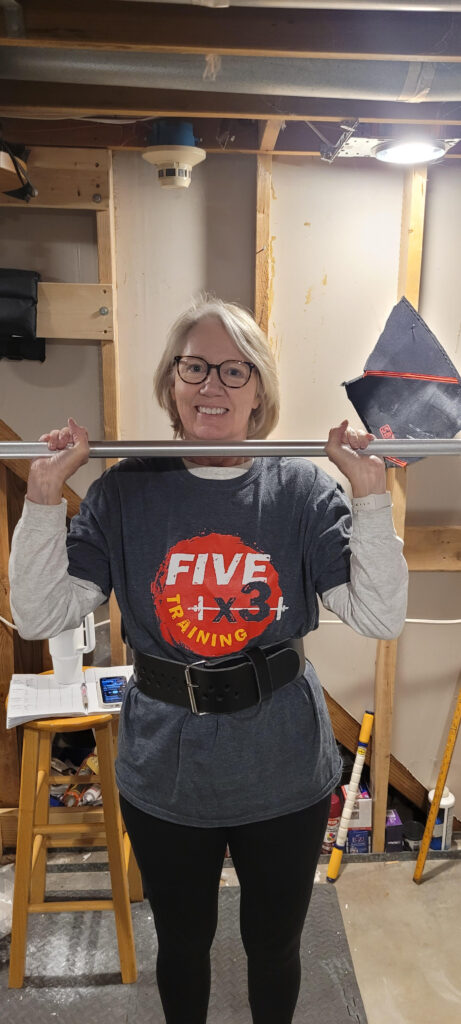
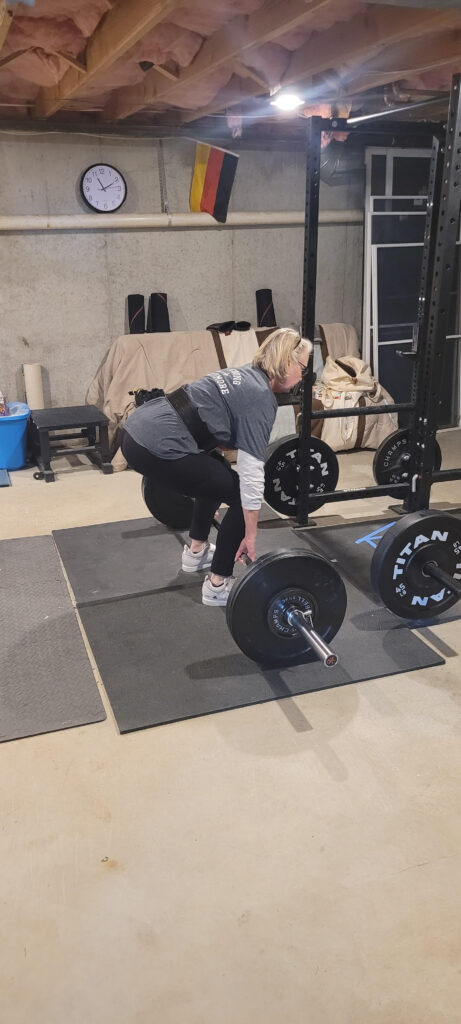
Strength training. After about three years of listening to her husband tout the wonders and benefits of strength training, Becky decided it was time to give it a try. She had had a left hip replacement a couple years prior to beginning her program and was hesitant to try squatting and deadlift due to her hip. Nonetheless, in 2024 after her scan, she started seriously training–squatting, pressing, benching and deadlifting. Her hip started feeling better. She began to feel stronger and more capable. She was feeling more confident in her body, no longer worrying about her hip. And now, two years later, her scan verifies the progress she has made in increasing her bone mass.
In addition to strength training three times a week, Becky also takes Vitamin D3 50 mcg (2000 IU) daily as well as one tab of SlowMag Muscle & Heart Magnesium Chloride Supplement with Calcium (119 mg calcium) and eats cheese or cottage cheese daily and occasionally yogurt. She takes PreserVision AREDs which she swears keeps away colds and flus although she takes it as a preventative measure for macular degeneration as all the women in her family get it eventually. She also takes L-Lysine for fever blisters which also helps with calcium absorption.
Becky is not alone in her quest to make her bones stronger. She is one of many, many, many women who are turning to strength training as a way of changing the way one ages. By implementing resistance and weight-bearing exercises to stimulate bone formation, women can reverse bone loss. Women who lift weights, especially heavy weights such as the compound barbell movements (squats, deadlifts, presses), tend to maintain or even improve their bone density. Taking an adequate intake of calcium and vitamin D is essential as Vitamin D helps the body absorb calcium and maintain healthy levels in the bloodstream. Women with vitamin D deficiency (below 30 ng/mL) are at greater risk of bone loss and fractures. Not smoking, having a moderate alcohol consumption, and very low body weight all increase the risk of osteopenia and osteoporosis. Identifying these factors early can allow for lifestyle interventions that preserve bone mass.
Strong bones are not built in a day, but the decision to start protecting them can be.