Across gyms, more and more women are turning away from medicine and turning to strength training as a way to combat loss of bone density, muscle and strength. As they should.
Last week, I shared a post about Becky, a 64 post-menopausal woman and her success after beginning a strength training program right after her DEXA scan in 2024.
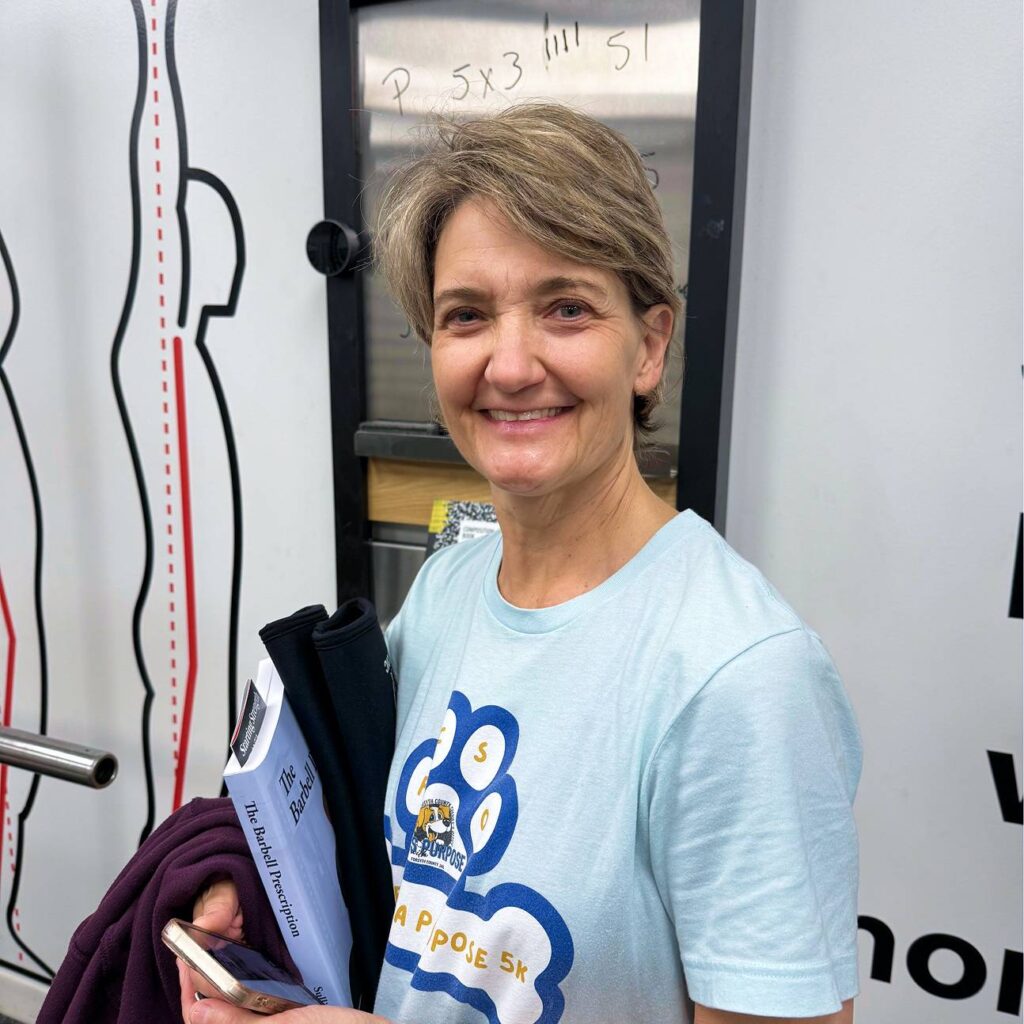
Now meet Julie, a 59 year old post-menopausal woman.
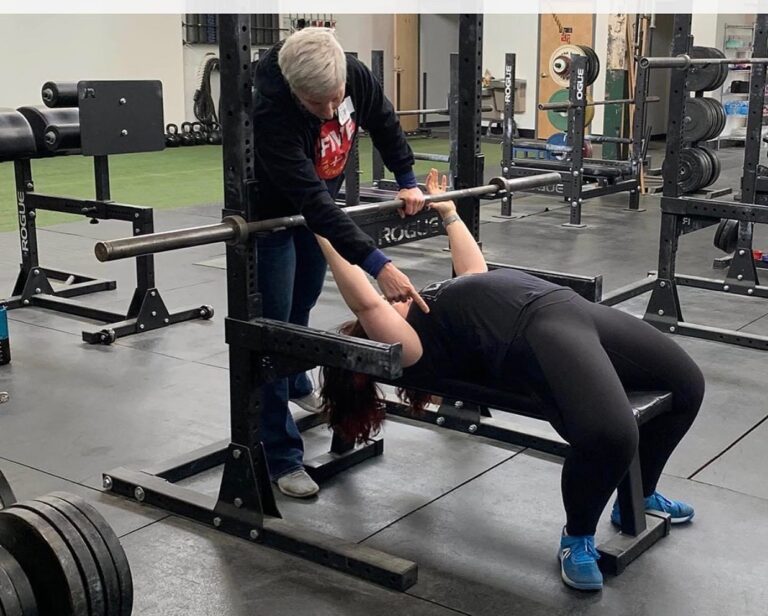
She is a client in Atlanta, training at Starting Strength Atlanta with our colleague, Adam Martin.
In 2009, Julie broke her wrist. Post wrist fracture, she started a regimen of vitamin D, a multi-vitamin and calcium. Fast forward to 2024. She had a DEXA scan at the age of 57 in November of 2024 and was diagnosed with osteoporosis, specifically in her lumbar spine and left femoral neck.

Her T-score in her lumbar spine (L1–L4) was ?3.0, well below the World Health Organization’s criteria of -2.5 for osteoporosis. The T-score for the left femoral neck was ?2.7, also osteoporosis. The t-score for the left hip: ?2.2, osteopenia, which is categorized as between ?1.0 and ?2.5. The t-score of her right femoral neck was ?2.1, also osteopenia as well as the right hip which had a T-score of ?1.5.
Unfortunately, she meets the criteria for osteoporosis, because at least one site (in her case, multiple sites) had a T-score ? ?2. Her lumbar spine (?3.0) was the most concerning value and indicates more significant bone loss in that region.
Her doctors told her after this diagnosis in 2024 to just “take medicine” and that drugs were the only option and the best she could hope for would be to keep it from getting worse.
She refused to just “take medicine.” She did a Google search and learned about strength training and Starting Strength. “I’m going to try to train my way out of this,” she said to herself and contacted Adam at Starting Strength Atlanta. She started strength training in July of 2025, 8 months after her first DEXA scan.
She got a second DEXA scan this past March 2026, nine months after beginning her strength training program at her new gym. And in just 9 months, she made dramatic improvements in her bone density with no medicine, just barbell training.
Her T-score in her lumbar spine (L1–L4) is now ?2.5, just on the edge for osteoporosis. The T-score for the left femoral neck is now 2.3, which means it is no longer in the osteoporosis range but now osteopenia.. The t-score for the left hip is now ?1.7 and the t-score of her right femoral neck is also -1.7. Her right hip now has a T-score of ?1.0 which means it is approaching normal!!
Here is a comparison of T-Scores:
| Site | November 2024 | March 2026 | Change | Interpretation |
| Lumbar spine (L1–L4) | 3.0 | 2.5 | +0.5 | Significant improvement (still osteoporosis) |
| Left femoral neck | 2.7 | 2.3 | +0.4 | Improved -From osteoporosis to osteopenia |
| Left hip | 2.2 | 1.7 | +0.5 | Improved |
| Right femoral neck | 2.1 | 1.7 | +0.4 | Improved |
| Right hip | 1.5 | 1.0 | +0.5 | Improved (Approaching Normal!) |
These gains of +0.4 to +0.5 are clinically meaningful in bone density terms. The biggest concern area is still her spine, which is still in the osteoporosis range, but not as severe as before. This pattern suggests that bone density is increasing, not declining. Julie went from osteoporosis at multiple sites to osteoporosis at only one site (spine). Technically, Julie still has osteoporosis (because of the spine T-score of ?2.5). However, her overall fracture risk has most likely decreased and her hips, especially, are now in a much safer range.
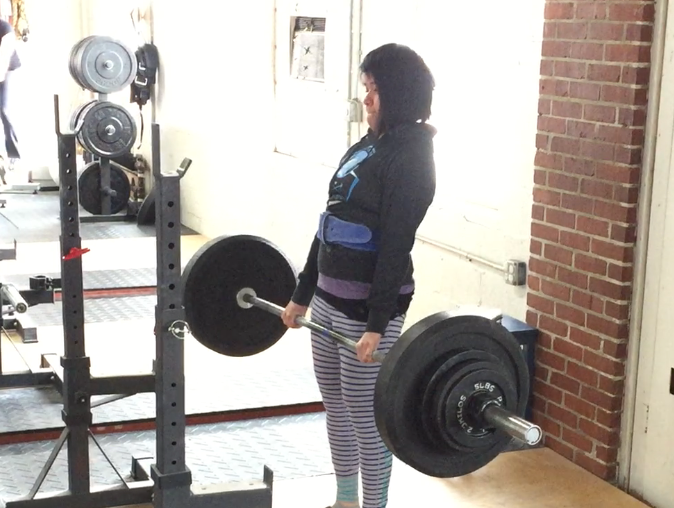
For the past 9 months, Julie squatted, benched, pressed and deadlifted. To have made such incredible improvements in just 9 months with only barbell training and vitamin supplements is not surprising to me. But I am sure it would be surprising to her doctors who told her to just “take her medicine.” Barbell training is “medicine.” And not only is Julie stronger and more capable, her bones are also stronger and she is definitely on her way to a healthier, more able body!!
Congratulations, Julie!